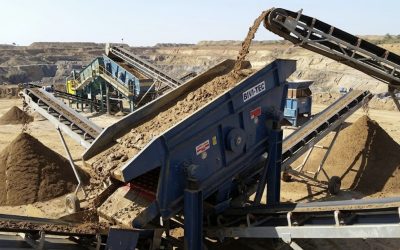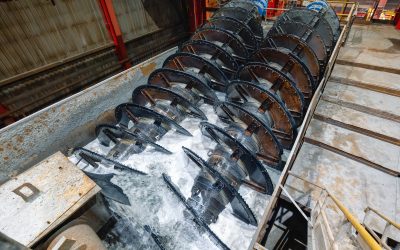
While traditional sand washing equipment does a good job cleaning and classifying certain materials, excess moisture and abrasive materials can create challenges that lead to efficiency loss, increased wear and tear, and operating costs. However, the Ortner® provides an efficient solution for washing, classifying, and dewatering sand while minimizing downtime and maintenance requirements.
Why Wet and Abrasive Materials Cause Problems
Wet materials quickly clump together, clog up machinery, and make it difficult to separate fine materials and usable product from the discard. Additionally, abrasive particles wear down sand washing machines, causing increased maintenance, plant downtime, and reduced equipment life.
As moisture levels and abrasion increase, producers can expect:
- Material carryover to increase
- Reduced output quality
- Frequent shutdowns
- Higher repair costs
- More frequent parts replacement
- Difficulty producing a dry product
For most aggregate producers, conventional sand washers also require exorbitant amounts of water and power, yet struggle to produce a consistent, dry, high-quality output.
Traditional Sand Washing Machines and How They Work
There are several unique sand washers used across the aggregate industry. Most commonly used washers are:
- Classifying tanks: use settling to separate by size, but excess moisture and fluctuating feed conditions can make precise classification more difficult
- Bucket wheel washers: can struggle to efficiently remove ultra-fine particles while maintaining product consistency
- Screw washers: move material through a submerged trough, but abrasive materials often increase wear on the screw flights
- Log washers: do a great job scrubbing materials but often wear down quickly, requiring regular equipment and part replacements
Learn how the Ortner compares to traditional log and screw washers.
One of the biggest challenges with traditional sand washing systems is that washing, classification, and dewatering often occur as separate processes. As a result, operators may need multiple pieces of equipment to achieve the desired product specifications.
Why the Ortner® is a Better Sand Washing Machine
Designed to overcome the limitations of conventional equipment, the Ortner® combines dewatering, fines removal, classification, and rinsing into one single machine. By removing unwanted materials (such as silt, dust, and excess fines), the Ortner® helps producers improve sand quality and consistency while maximizing the recovery of desired material.
How it works:
- Material enters a slow, revolving, inclined pan that’s vibrated at a high frequency
- Materials are separated by size
- Fines and water are discarded while coarse particles carry upward
- All upward-carrying products are discharged and dewatered
The advantage of this process is efficiency. The Ortner® uses one-third the water required by conventional dewatering equipment, resulting in lower overall power consumption. The machine’s simple, compact design also helps reduce wear and maintenance requirements, even when processing highly abrasive and wet materials.
If wet or abrasive materials are causing you operational challenges, the Ortner® may be the right solution. Contact our team today to discuss your needs and learn how the Ortner® can improve your operation.