In aggregate, mining, and sand processing, effective dewatering improves product quality, plant efficiency, and operating costs. Removing excess moisture creates a more marketable product, reduces handling and transportation issues, and supports downstream processing. The challenge is removing water efficiently without losing valuable fines or wasting energy, water, and maintenance resources.
In this article, we’ll compare several common types of dewatering equipment used in aggregate and mining applications
What to Look for in Dewatering Equipment
Water Consumption
Water use can have a major impact on operating costs, especially in areas where water availability is limited or recycling is important. Some dewatering systems require larger volumes of process water, while others are designed to recover water more efficiently and reduce overall consumption.
Product Dryness
One of the main goals of dewatering is producing a low-moisture product that is easier to stockpile, transport, and sell. Different systems achieve different moisture levels, depending on material type, particle size, and operating conditions.
Maintenance Demands
Maintenance requirements can vary widely, depending on the complexity of the system and the number of wear components involved.
When comparing different types of dewatering equipment, consider access to parts, routine service needs, wear rates, and potential downtime. Lower maintenance demands can translate into better uptime and lower long-term operating costs.
Learn how to reduce water use, produce a drier product, and simplify maintenance.
Power Requirements
Different types of dewatering equipment vary significantly in energy demand. Motors, pumps, vibration systems, and other mechanical components all affect power consumption. Evaluating long-term energy costs — not just upfront equipment cost — can help determine the most efficient fit for your operation.
Throughput and Capacity
Production goals should drive equipment selection. Consider how much material the system needs to process per hour and whether it can maintain performance during peak production periods. A system that cannot keep up with plant throughput can quickly become a bottleneck.
Footprint and Portability
Available plant space can influence equipment choice. Some dewatering systems require a larger installation footprint, while others offer a more-compact design.
For portable plants or operations that need flexibility, mobility and ease of relocation may also be important.
Ability to Classify and Wash while Dewatering
Some systems do more than remove water. Equipment that can classify material, remove unwanted fines, and wash while dewatering can improve overall plant efficiency and reduce the need for additional equipment. This can simplify plant design while helping produce a cleaner, more consistent final product.
Types of Dewatering Equipment
Here’s a breakdown of the most common types of dewatering equipment found in aggregate, mining, and sand processing operations.
Fine Material Screw Washers (Sand Screws)
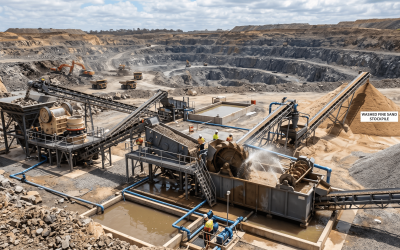
Sand screws are a common dewatering solution in aggregate processing. They use a rotating screw to lift sand from a water-filled trough, so it can drain before discharge. They are widely used because they are simple to operate, familiar to plant crews, and effective for dewatering coarser sands at moderate throughput.
However, they typically use significant amounts of water, often lose very fine particles in the overflow, and can experience wear on screw flights and bearings. Their classification ability is also limited, so additional equipment may be needed when tighter particle sizing is required.
Log Washers
Log washers are heavy-duty machines designed to clean coarse aggregate contaminated with clay, loam, and other stubborn materials. They use rotating paddles in an inclined trough to aggressively scrub particles as they move through water.
While effective for heavily fouled material, log washers are large, energy-intensive, and costly to install and maintain, with wear parts that require regular attention. For moderately clean material, they are often more aggressive than necessary.
Compare the Ortner to traditional log and screw washers.
Classifying Tanks
Classifying tanks separate material in water based on particle size and density, with coarser particles settling to the bottom while finer particles remain suspended and exit in the overflow.
They can handle a range of particle sizes with relatively simple mechanics and few moving parts. However, they require a large footprint, a continuous water supply, and slower processing times, which can make them less practical when space or water availability is limited.
Hydrocyclones
Hydrocyclones use centrifugal force to separate particles from water, with coarser material exiting through the underflow and finer particles leaving through the overflow. They offer high throughput, have no moving parts, and are especially effective at removing ultra-fine particles.
The trade-off is that they require significant pump energy and do not fully dewater material on their own, so they are often paired with a dewatering screen or other secondary equipment to reduce moisture content.
Vibrating Dewatering Screens
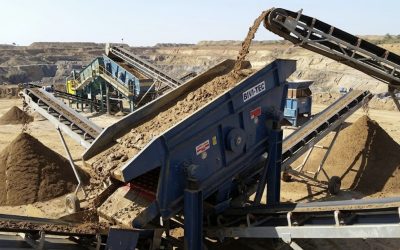
These machines move material across a steep, high-frequency vibrating screen that drains water while conveying solids to discharge. They offer high throughput in a compact footprint and are commonly used as a secondary dewatering step alongside equipment like hydrocyclones or screw washers.
While they can significantly reduce moisture, screen media requires regular maintenance, and they offer limited ability to classify material or remove fines.
The Ortner® Sand Classifier
The Ortner®, manufactured by Aggregates Equipment, Inc. (AEI), takes a fundamentally different approach to dewatering — and the results speak for themselves.
The Ortner uses a rotating, vibrating inclined pan to quickly separate water, fines, and coarser material. Unlike many other dewatering systems, it simultaneously dewaters, classifies, washes, and removes fines in a single pass. Plus, its protected drive and vibration components are mounted beneath the pan, reducing wear and extending component life.
Compared with many alternatives, the Ortner uses roughly one-third the water and one-third the power, while producing a drier, more consistent final product. It can handle material up to 3 inches in size, and its compact design makes it easier to integrate into existing plants or portable setups.
To learn more or to arrange a test of your material sample, contact AEI Screens.